
Vanish Designs · Journal
How Game of Thrones and the Pandemic Led to the Creation of Vanish Designs
A founder story about interior design, entertainment, and a better alternative to wall-mounted TVs.
By Mark Motyl, founder of Vanish Designs
In the spring of 2020, my children staged what can only be described as an intervention.
“Dad,” they informed me, “you are finally watching Game of Thrones.”
The world had just shut down. Everyone was home. My kids, 15, 18, and 19 at the time, had decided that the pandemic was the perfect opportunity to force me into one of the great cultural experiences I had managed to avoid.
All eight seasons. Roughly seventy hours.
I had reservations.
Not about the show. Everyone I knew said it was fantastic.
My hesitation was more practical: I didn’t particularly want to spend two months staring at a TV.
If I was going to spend 70 hours watching a show, I at least wanted the experience itself to be immersive.
So I did what any reasonable person would do: I bought an inexpensive projector, a folded fabric screen, a soundbar, and I carried everything down to our unfinished basement, and a deeply unglamorous home theater.
The setup was objectively ridiculous.
A year earlier, I had envisioned, financed, and served as the general contractor for 66 Beachside Avenue in Westport, Connecticut - a spec home that would go on to sell for the highest price ever paid for a new-construction spec home in that town.

66 Beachside Avenue in Westport, Connecticut. Architect: Christopher Pagliaro
And there I was in my basement, tethering a fabric screen to the exposed studs because my children wanted me to watch dragons.
But it worked.
The image was enormous and brilliant. The sound filled the room. The experience was completely different from television.
Game of Thrones, at cinematic scale, with rich sound and a large screen capable of pulling you into another world, felt transformative in a way I hadn’t expected. I became fascinated not only with the show, but with the format itself.
And somewhere around Season Three, I fell into a rabbit hole.
The Rabbit Hole
I started reading about ultra-short-throw projectors.
UST technology, if you haven’t encountered it yet, fundamentally changes the geometry of projection. Traditional projectors sit ten or fifteen feet away from the screen and throw light across the room. Ultra-short-throw projectors sit just inches from the screen itself.
That may sound like a small technical distinction, but it changes everything.
Because if a projector can sit inches from a screen, it can potentially live inside furniture, along with an automatic screen and a sound system.
At the time, UST technology was still new. I bought one of the first serious models to hit the market, the VAVA 4K, along with a motorized ambient-light-rejecting screen designed specifically for UST use.
Then I made another completely rational decision:
I turned our living room into a woodworking shop.
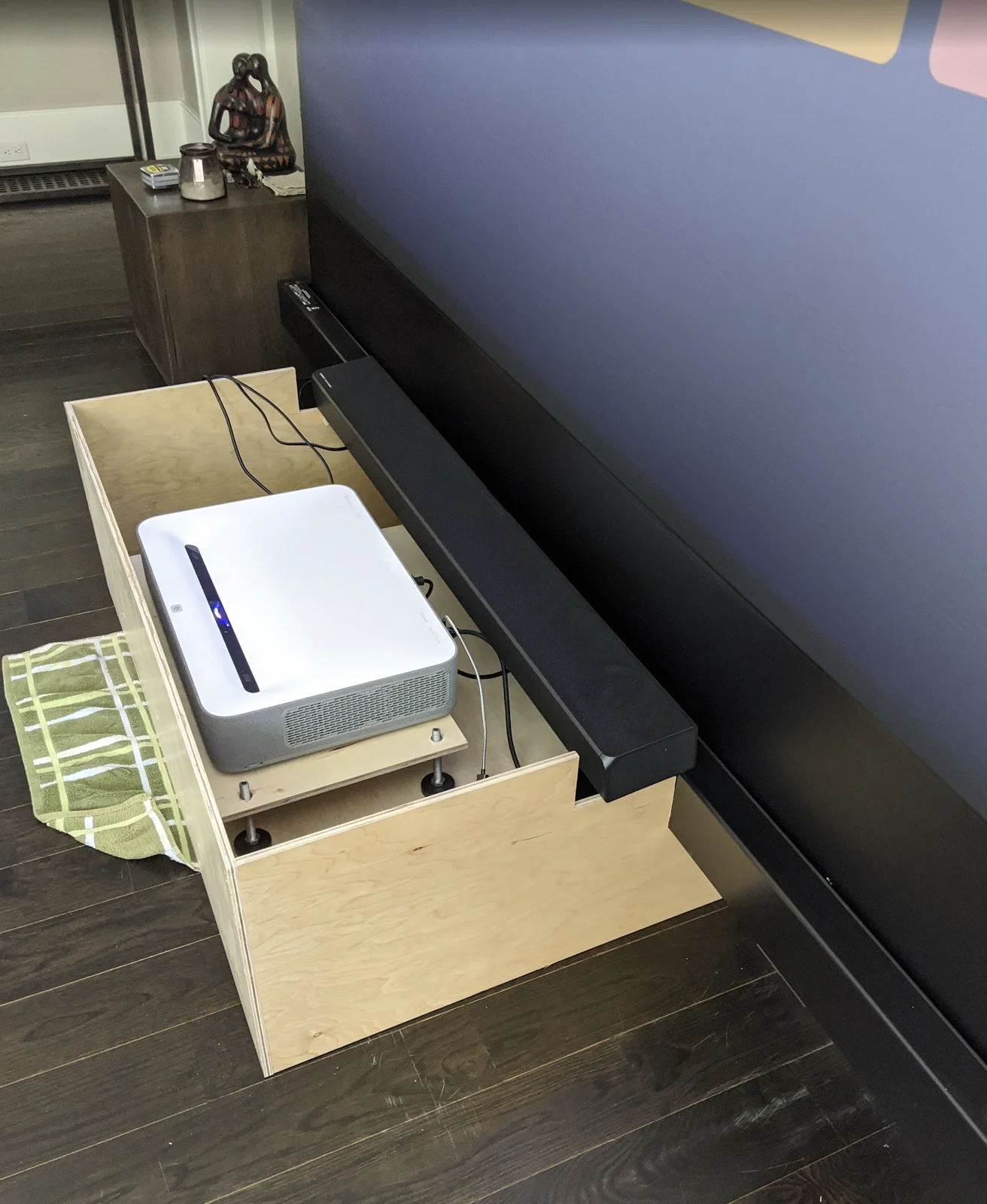
One of the first prototypes. My wife was extraordinarily patient.
There were prototypes everywhere. Sawdust everywhere. Random AV parts arriving at our Westport home almost daily. I’d wake up thinking about projection geometry and go to sleep thinking about furniture design.
And underneath all of it was a realization that had actually been building for years.
The Problem I Was Really Trying to Solve
Before Vanish Designs, I had built a number of luxury homes.
And over time, I became increasingly aware of something almost nobody had a good answer for:
The television.
Not the technology itself - televisions are incredible technologically - but what they do to rooms.
You could spend years designing a beautiful home. Extraordinary millwork. Carefully balanced proportions. Stunning fireplaces. Incredible views. Beautiful materials.
But when it came time to furnish the main living spaces, something strange would happen: the rooms would inevitably organize themselves around a giant black rectangle or a glowing piece of “art” mounted to a wall.
Furniture placement became subordinate to the TV.
Views were compromised.
Fireplaces became secondary.
Entire living rooms quietly shifted away from how people naturally wanted to live and toward the demands of a screen.
And the existing solutions never fully satisfied me.
Traditional wall-mounted televisions are fine until you want them to disappear. Then suddenly you’re opening walls, rerouting power, recessing cavities, coordinating contractors, repainting drywall, and making a surprising number of compromises.
The audio situation is its own separate mess. Televisions sound terrible, so now you need soundbars, speakers, wires, in-wall systems, complicated remotes, or equipment racks hidden somewhere else in the house.
And dedicated home theaters - while spectacular in certain homes - often felt strangely disconnected from daily life to me.
I don’t necessarily want to disappear into a dark basement cinema or a special media room to watch baseball or the evening news. I want to be in the actual living spaces of the home. Near the kitchen. Near the fireplace. Near everyone else.
Screening rooms are among the most expensive rooms in many homes, and they are often the least used.
I envisioned something different:
A captivating cinematic experience in the rooms where people actually live - - and a system that disappeared completely when it wasn’t being used.
The Realization
The breakthrough wasn’t simply the projector.
It was realizing that fine furniture could become architecture for entertainment.
Not “media consoles.”
Not AV cabinetry.
Actual furniture - pieces beautiful enough to belong in extraordinary rooms entirely independent of the hidden technology inside them. Furniture that even the most discerning people would love to have in their homes anyway.
That idea eventually became Vanish Designs.
Today, our Westchester, NY bench-made credenzas, window seats, dressers, and console tables conceal complete cinematic systems: ultra-short-throw projectors, motorized ambient-light-rejecting screens, Dolby Atmos audio systems, and all of it controlled by the elegant and powerful Apple TV streaming device.
When activated, a screen silently rises from the furniture and transforms the room into a jaw-dropping large-scale entertainment experience.
When finished, everything disappears.
No visible TV.
No construction.
No wall demolition.
No permanently dominant screen.
And perhaps most importantly: the furniture still functions fully as furniture.
The window seats are real window seats. People sit on them.
The dressers contain real drawers.
The credenzas provide actual storage.
The entertainment technology occupies surprisingly little of the furniture itself.
What surprised me most was how strongly interior designers and architects responded once they saw this in person.
Many had been trying to solve this problem for years.
Not the technology problem.
The room problem.
Why I’m Writing This
This Substack will be partly about Vanish Designs which, in just five years, has placed its systems into many of the most beautiful homes in the New York metro area and beyond. More broadly, it will explore the intersection of technology, architecture, design, entertainment, and how we actually live inside our homes.
What began as a Covid-era experiment has evolved into something much larger: a growing luxury lifestyle brand built around the idea that beautiful rooms deserve better solutions for entertainment than giant wall-mounted TVs.
I’ll write about ultra-short-throw projection, emerging AV technologies, and why most people still don’t understand what modern projection systems are capable of.
Why TVs above fireplaces became normalized despite their many shortcomings - and why that is starting to change.
Why dedicated home theaters often go unused.
Why many “smart homes” became absurdly overcomplicated - filled with wall panels, confusing remotes, software glitches, and systems nobody actually enjoys using.
Why preserving room for real art, fireplaces, natural light, and views to the outside may matter more than ever - particularly as architects and designers increasingly embrace biophilic interiors.
And occasionally, I’ll share installations and real-world examples that support a larger idea: entertainment in beautiful homes can be done substantially better.
I also believe we’re at the very beginning of a major shift in how people experience entertainment at home - and we intend to document that shift as it happens.
Unlike much of what gets written about technology these days, this actually affects how people live - the rooms we gather in, the way we relax, and ultimately how our homes feel.
If any of that sounds interesting, I hope you’ll subscribe.
And if you’ve been living with the black-rectangle problem longer than you’d like, I’d love to hear from you.